
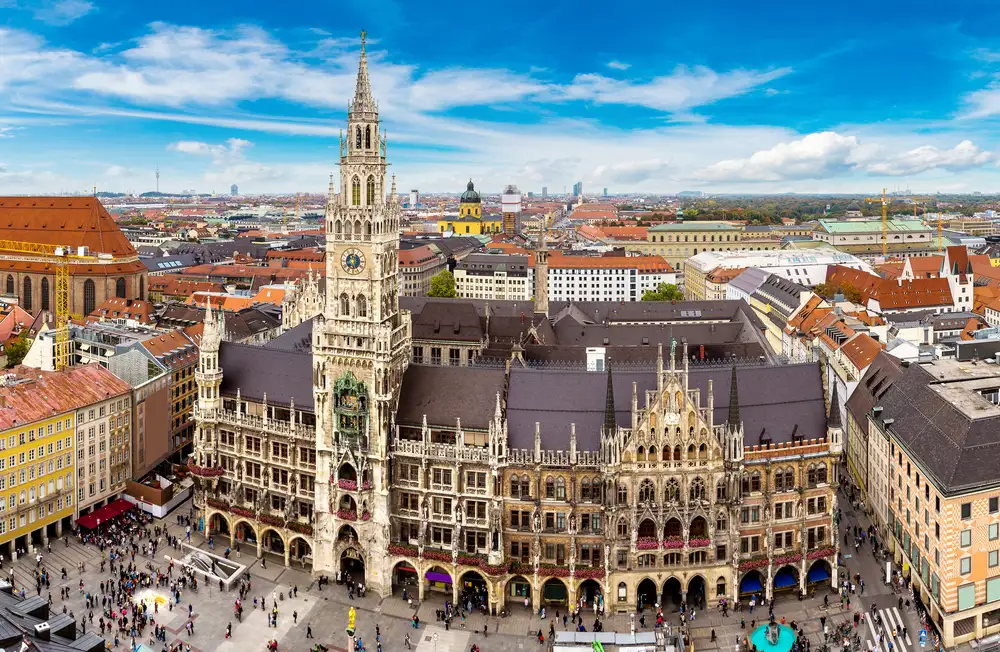


Munich Travel Guide

Must See Attractions in Munich

Old Town Munich is the perfect place to familiarize yourself with Munich's history. Walking these streets studded with medieval, renaissance, and baroque buildings, you can easily imagine the old Bavarian way of life. The Old Town was at the heart of the wedding festivities of Ludwig I to Princess Therese of Saxe-Hildburghausen, celebrations which ultimately became the Oktoberfest. The Old Town is also where you'll find some of Munich's most prestigious beer halls, including the famous Hofbräuhaus, a tavern, and brewery that has been serving beer for nearly 500 years. When the King of Sweden threatened Munich in 1632, he was appeased with 600,000 barrels of Hofbräuhaus beer. Stopping for a stein or two at a beer hall is a great way to drink up some authentic traditions as you tour the Old Town.
Read more

A highlight of any trip to Munich, the royal residence was home for the Wittelsbach monarchs for centuries. Originally a medieval castle, over the centuries, the castle was transformed into a beautiful palace, the largest of its kind in Germany. Now open to the public, you can explore the Residence's magnificent interiors, numerous courtyards, and elegant gardens. This is truly the palace to end all palaces. The Antiquarium Gallery is especially stunning. Designed to impress and intimidate any guest, the gallery's paintings and lunette windows are an opulent display of wealth and power. The living quarters of the royal family, now a museum, provide a glimpse into the intimate lives of Kings and Queens. If this wasn't enough, the palace also exhibits the many precious jewels collected by Bavaria's rulers.
Read more
The Deutsches Museum (i.e., the German Museum) is the world's largest museum of science and technology. It's located on a small island in the River Isar, which flows through central Munich. The museum's vast and fascinating collection is spread out among 40 different exhibitions. You will encounter examples of technology stretching across humanity's long history, from a reproduction of prehistoric cave paintings to the laboratory where the atom was split. It is also fascinating to view exhibitions about WWI and II from a German perspective, including a real U-boat. With so much to offer, especially for family groups, visiting the Deutsches Museum makes for a great half or even full-day visit.
Read more
Ever seen people surfing in a city park? The English Garden in Munich is one of the most well-loved parks in the world. The perfect place to escape the city, the Gardens include a manufactured surf wave in an artificial stream. Surfers line up for a turn on the wave, to a crowd cheering them on even when they wipe out. It makes for great people watching. Stroll further into the park and you'll find delightful follies, such as a Chinese tower, Monopteros temple, and a Japanese teahouse. You may even run into a flock of sheep. When you are ready for some refreshment, you can find several large beer gardens in the park, where you can mix with the locals and enjoy some of Munich's famous brews.
Read more
The most famous beer festival in the world, Oktoberfest is Munich's number one claim to fame. This annual festival, held from late September to early October, draws millions of people every year and must be seen to be believed. Imagine a giant, festively decorated tent filled with 6,000 people. Dressed in traditional Bavarian lederhosen and dirndls, everyone rowdily drinks beer from giant steins. Wurst and pretzels are served, and everyone is merrily singing along to a polka band. Oktoberfest originated in 1810 when the wedding celebrations of a Bavarian King spilled over into the streets of Munich. Inspired locals began marking the wedding annually with a horserace, a fair, a parade, and of course, plenty of beer.
Read more
If you have a passion for cars and German engineering precision, then you will love the shrines to one of Germany's finest automobiles - the ultra-modern BMW Museum and the futuristic-looking BMW World. The silver bowl-shaped museum comprises seven themed 'houses', which include more than 120 of the most eye-catching automobiles, motorcycles, and engines from nine decades of BMW history. Even if you can't tell a camshaft from a crankshaft, the interior design – with its curvy retro feel and kinetic sculptures – is reason enough to visit. Directly across the space-age footbridge on the other side of the road, the BMW World multi-use exhibition center is where buyers take delivery of their BMW vehicles. You can sit inside the very latest BMW models and imagine yourself at the wheel.
Read moreShow more
Optional Day Trips from Munich

Neuschwanstein is one of the most famous castles in the world. Perched on a peak in the foothills of the Alps, the spiraling towers and turrets of the castle overlook the piney forest floor below. This is the castle that inspired Walt Disney, numerous fairy tales, and countless dreamers. The castle was built in the 19th century by the reclusive and eccentric King Ludwig II as an escape from society and a way to pursue his favorite passions. Ludwig was heavily influenced by the romantic château of rural France, and the music of his friend, opera composer Richard Wagner. Sadly the King was declared insane, deposed, and then mysteriously died, having only slept 11 nights in the unfinished palace. Today you can tour the castle's striking interiors and roam the grounds by the dramatic Pöllat Gorge.
Read more
Often referred to as the "Bavarian Sea", Chiemsee is Bavaria's largest lake, and it's a majestic one. The lake is home to three beautiful islands; Herreninsel, Fraueninsel, and Krautinsel. Just an hour by train from Munich, a trip to the lake is easily accommodated into even a busy itinerary. All three islands are connected by regular ferry to the mainland, so you can pick and choose where to explore. Herreninsel boasts a mansion built by Ludwig II to mimic Versailles, a feast for the eyes of gold, with painted ceilings and luxury porcelain. Fraueninsel was an 8th-century convent, which today is more known for its fine Bavarian restaurants. If you feel adventurous, you can easily rent an electric motorboat to venture out onto the lake or use a to cycle around the entire lake for scenic views.
Read more
Nestled at the foot of the Bavarian Alps, Garmisch-Partenkirchen is the German capital of alpine skiing and summer hiking. Take a ride on the famous Zugspitzbahn railway and then a cable car up to the peak of Germany's tallest mountain, the Zugspitze, for some truly breath-taking views. Alternatively, you can alight from the railway halfway up the mountain and go hiking around the Eibsee lake. This area has some of the most postcard-perfect scenery in Germany. Or, head up the Partnach Gorge from the Garmisch train station and immerse yourself in the gorge's rocky crags and waterfalls. With enough energy and time, you can even walk all the way up to Königshaus am Schachen, one of 'Mad' King Ludwig II's more unusual building projects.
Read more
One of humanity's darkest evils began in the inconspicuous small town of Dachau when an abandoned munitions factory was converted into the first Nazi concentration camp in 1933. The Dachau concentration camp would come to serve as a model for all of the Third Reich's future concentration camps, in which millions of innocent lives were extinguished. Visitors follow the "path of the prisoner", passing through the iron gates proclaiming "Arbeit Macht Frei" and going through the processing points where inmates were stripped of their belongings and dignity and began a daunting struggle for survival. A visit to this traumatic site increases understanding of the holocaust and offers a chance to reflect on the horrors of Germany's past.
Read more
Named after the Roman Emperor Augustus, Augsburg is one of Germany's oldest cities. It is one of the main attractions along Bavaria's famous Romantic Road, thanks to its impressive architecture. The town was developed as a financial center during the middle ages, and the look of wealth and prosperity remain. Take a day trip from Munich and stroll through the city's ancient streets, discovering Augsburg's superb fountains, grand guild houses, and the onion-domed towers of its city hall, which locals claim is the most significant secular Renaissance building north of the Alps.
Read more
Settled peacefully on the banks of the Danube River, the delightful little town of Neuburg an der Donau is a perfect day trip for those looking to get off the beaten tourist track. Visit the charming castle sitting above the river, and explore the narrow streets of this historic old town, full of beautiful examples of Baroque and Renaissance architecture. Despite its name, which means "new castle on the Danube" Neuburg an der Donau certainly isn't new, having come to prominence after the founding of the principality of Pfalz-Neuburg in 1505. You'll swoon over the aristocratic mansions, imposing churches and the Rococo provincial library, all but a few reminders of Neuburg's rich heritage.
Read moreShow more
Create a custom trip
plan for Munich
Travelling made easy:
- ✓ 100% customizable trip
- ✓ On-trip support, around the clock
- ✓ Local travel expertise


Featured Blogs




Your custom trip package includes

A day to day itinerary

Centrally located hotels

Door to door transportation
Self-guided & private tours
Create Your Perfect Trip in Minutes
Discover A Better Way To Travel.
Once you Go Real, you’ll never go back to ordinary travel.
Hi! Need help planning your dream trip? 🌍