




Cesky Krumlov Travel Guide

Must See Attractions in Cesky Krumlov

Český Krumlov Castle stands guard over the picturesque little town in all its ancient glory. Originally built as a Gothic castle in 1250 by an important branch of the Rosenberg family, it continued to change hands within noble families until it finally fell into the possession of the Czech state. As you can imagine, the castle architecture transformed through all those years to become the unique work of art you see it as today. The castle complex is directly accessible from the city center, so there’s no excuse not to explore it. Head to the castle museum, or climb to the top of the tower for panoramic views of the city. Visit the exquisite Baroque gardens, which make up the largest part of the castle grounds. Walk through the various courtyards and admire the architecture before heading inside to see the theatre, the cellars, and the preserved furnishings. No matter how much or how little of the castle grounds you explore, the beauty will take your breath away.
Read more

Housed in the Český Krumlov Castle, The Baroque Theatre is the best-preserved Baroque theatre in Europe. Built in the 1600s when the castle was in the hands of the Eggenberg family (yes, the same one their local beer is named after), it was later reconstructed and renovated by the Schwarzenbergs in the 1700s. This was the last round of renovations the theatre underwent, so the Baroque Theatre you see today is the same as it was back then. When you visit the Baroque Theatre, you’ll get to see not only the perfectly-preserved stage and auditorium in their original forms, but also marvel at setpieces and scenery, costumes and props, and even surviving scripts and scores from shows performed during years past. Take a tour to learn about Baroque theatre life in times of old and be awed by the architectural and mechanical details that have been carefully preserved.
Read more
The other spire that dominates the town of Český Krumlov along with the castle belongs to St. Vitus Church. This church was established as a Roman Catholic parish in the Gothic style in the 14th century but was expanded throughout the years to accommodate a growing population. As a result of these expansions, you will see several later architectural styles coming together to create the landmark you see today. Step inside St. Vitus Church to get the full experience. The interior’s components include richly colored paintings, furnishings, and intricate instruments, as well as historical relics. Although the Czech Republic is mostly atheist, St. Vitus Church is still used for religious services to this day. If you’re not interested in attending a service, they also hold classical music concerts there occasionally.
Read more
For all you art lovers out there, this is a must-see during your visit to Český Krumlov. Dedicated to the life and work of Austrian painter Egon Schiele (1890-1918), this museum was established in 1993 by three individuals who saw an opportunity after the fall of the Iron Curtain to establish an international art center. This museum houses, of course, a permanent exhibition documenting Egon Schiele’s life and works. It also includes an extensive collection of his paintings, plus rotating exhibits of both classical and contemporary art by other artists. This private institution has become internationally recognized for encouraging the growth and education of young artists. There are several art studios and writers’ rooms for rent so people are free to pursue their own endeavors in this creative and inspiring environment.
Read more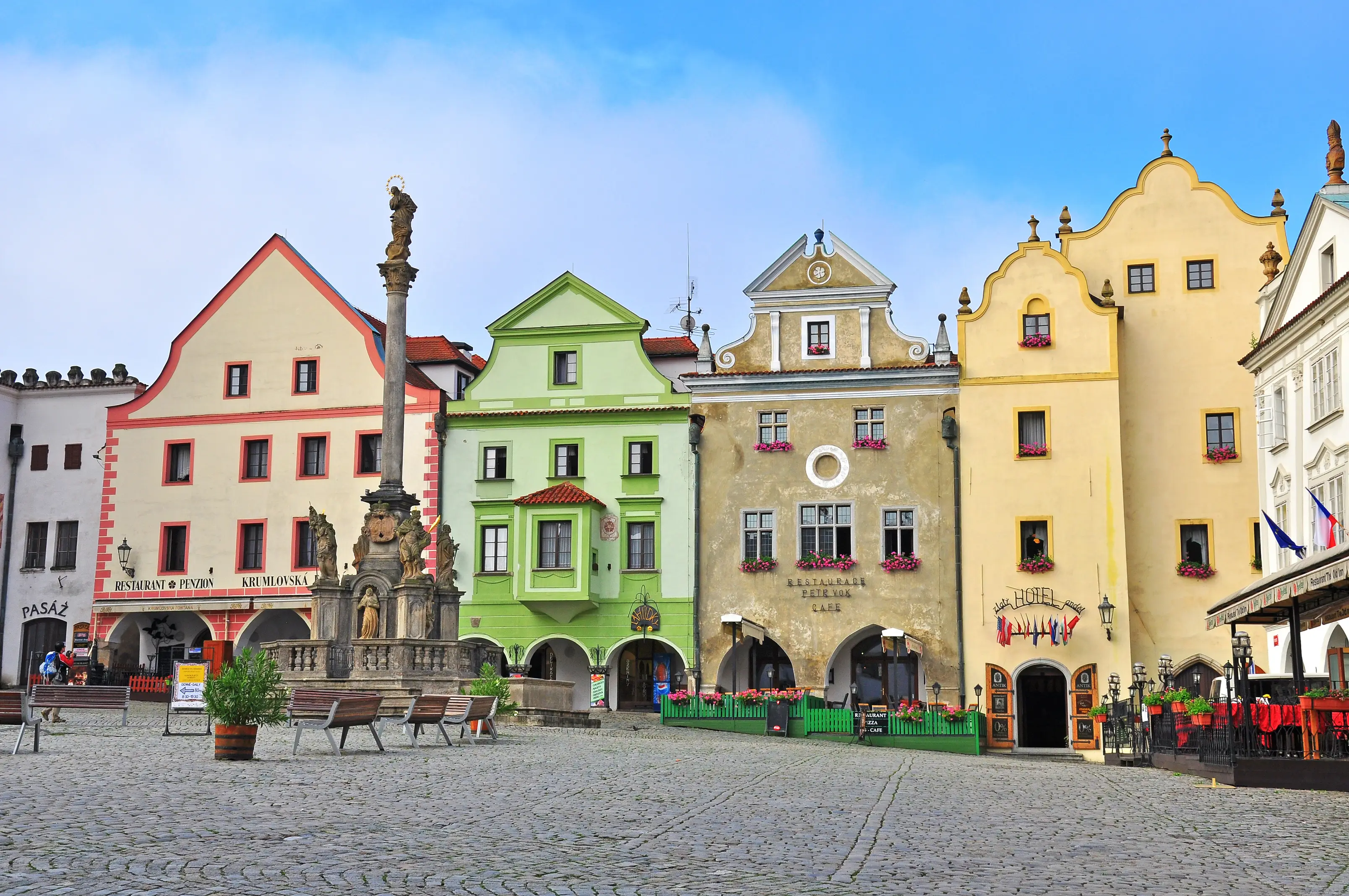
What’s a visit to a European city without seeing the main square? Svornosti Square is the Town Square in Český Krumlov, established in the 13th century, while the beautiful surrounding stone houses were built about a century after. However, the main landmarks in the Town Square were built even later. The Town Square’s centerpiece is an intricate fountain, along with the Baroque plague column topped with figures of the Virgin Mary and eight saints who were said to be the patrons of the town and protectors from the disease. The column was built in the 1700s as a piece of gratitude for the eradication of the plague from the town. The most notable building on the square is House No. 1, the Town Hall. The facade of this house was created by merging two existing Gothic buildings in the 17th century and bears four coats of arms: the Kingdom of Bohemia, the Eggenbergs, the Schwarzenbergs, and finally, the town of Český Krumlov itself.
Read moreShow more
Optional Day Trips from Cesky Krumlov

Often compared to the Windsor Castle in England, the Hluboka Palace is one of the most beautiful Czech castles in existence. Originally built as a guard castle in the 14th century, the style you see it in today is Neo-Gothic, after its most recent reconstruction in the 19th century by the Schwarzenberg family. Today, Hluboka Palace is one of the most visited monuments in the Czech Republic. You can explore the interior of the castle to see the royal chambers with their lavish wood decorations and furnishings, and admire paintings by European artists and portraits of the Schwarzenbergs. The stained glass and crystal chandeliers from Delft are among some of the most valuable artifacts within the palace. You’ll also want to take a leisurely stroll through the beautifully-manicured English-style gardens.
Read more
The town of Třeboň dates all the way back to the mid-12th century, but it wasn’t until the year 1300 that you could see the semblance of an organized town pop up. By the end of the 14th century, Třeboň had been transformed into a fortress complete with a castle, brick walls, and a moat. The town reached its peak during the reign of the Rosenberg family in the 16th and 17th centuries. Today, Třeboň is more of an authentic Czech spa town than a fortress. Třeboň is surrounded by thick forests and ponds, and the locals have taken full advantage of the nearby nature. Třeboň’s spas use peat as their source of treatment and healing, as peat abounds in the region’s bogs and ponds. If you don’t feel like checking out the spa during your visit, you can spend the day exploring Třeboň’s many historical monuments, such as the Town Square, the Gothic Třeboň Castle, the Augustinian monastery and church, and the gates to the city.
Read more
If you’re visiting during the summer and looking to add some water sports to your itinerary, Vltava River Rafting is the perfect choice. The Vltava River, the same river that runs through Prague, also runs right through Český Krumlov. The part of the river in and around Krumlov is much shallower than it is in Prague, making it more family- and beginner-friendly. Canoeing or rafting down the river is the perfect way to experience Czech nature like the locals do. Renting canoes, kayaks, or rafts is possible at many different starting points, whether you want to start upstream and end in Český Krumlov or start in Krumlov and go a little further downstream. Vltava River Rafting can be as relaxing or as adventurous as you want it to be - there are weirs along the way that you can choose to go down and bars in the middle of the river if you’d like to stop for a drink. No matter what you want your river rafting experience to be like, make sure to pass through the part of the river that actually goes through Český Krumlov, as it’s a unique way to experience the fairytale town as you cruise beneath the towers of the castle.
Read more
One of the best-preserved medieval monasteries in Europe, Zlatá Koruna Monastery was established in 1263 by Bohemian King Přemysl Otakar II. The Cistercian monastery is situated in a beautiful valley of the Vltava River near Český Krumlov and listed as a National Historic Monument. Today, you can admire the Gothic Chapel of the Guardian Angels, walk through the cloisters that housed religious life centuries ago, and visit the Church of the Assumption of the Virgin Mary, the largest church in the region of South Bohemia. You can also visit the monastic libraries, the permanent exhibition of Literature in South Bohemia, or delve into the lives of the 18th-century nuns.
Read more
Telč is yet another UNESCO World Heritage town in the Czech Republic and it’s easy to see why. This tiny town is one of the best examples of the Italian Renaissance north of the Alps. Originally established as a fortress with a moat, Telč dates all the way back to 1099 but owes much of its structure and prosperity to Zachariáš of Hradec, who took over the land in the 16th century. The main square in Telč is known to be one of the most romantic places in Europe. With its multi-colored houses, fountains and columns, pillars and vaulted arches, and outdoor cafes, this square is the perfect place to spend a leisurely day. What’s more, the Telč Chateau is situated at the tip of the square. The elegant chateau is a pristine piece of Italian Renaissance architecture that has been perfectly preserved. Enter the Golden Hall to gaze at portraits of Zachariáš’s ancestors and admire the intricate ceiling carvings. Or, take a tour of the luxurious living quarters of the last inhabitants of the chateau. By the end of your visit to Telč, you’ll feel like royalty.
Read moreShow more
Create a custom trip
plan for Cesky Krumlov
Travelling made easy:
- ✓ 100% customizable trip
- ✓ On-trip support, around the clock
- ✓ Local travel expertise


Featured Blogs




Your custom trip package includes

A day to day itinerary

Centrally located hotels

Door to door transportation
Self-guided & private tours
Create Your Perfect Trip in Minutes
Discover A Better Way To Travel.
Once you Go Real, you’ll never go back to ordinary travel.
Hi! Need help planning your dream trip? 🌍