



Heidelberg Travel Guide

Must See Attractions in Heidelberg
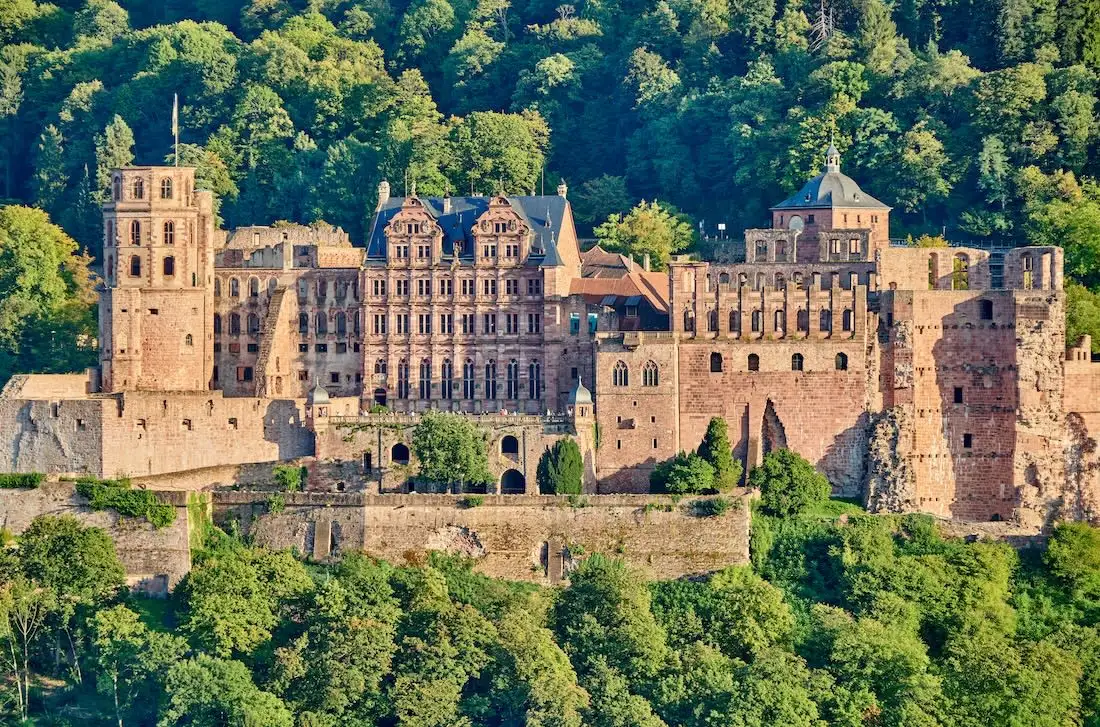
From the moment you arrive in Heidelberg, the tumbledown turrets and red stone walls of the city's castle beckon from the hillside above the Old Town. Once a grand palace of the Renaissance and home to the Rhine's nobility, over time, Heidelberg Castle was ravaged by fires, twice struck by lightning, and beset upon by townspeople, who used the stones and wood to build their houses. Somehow this has all served in the castle's favor. Inspecting the remains of the castle in 1880, Mark Twain wrote that the castle 'tumbled in such a way as to establish itself in a picturesque attitude… misfortune has done for this old tower what it has done for the human character sometimes — improved it.'
Read more

Like everything in Heidelberg, the Church of the Holy Spirit has seen some history. Holy Spirit's foundation stones were laid in in 1398, on the base of another even earlier church. Although its main structure is late Gothic, after the French set it on fire during the War of the Palatine Succession, Holy Spirit received a new baroque spire in 1709. Architecture isn't the only thing the church has switched throughout the ages. Holy Spirit has served both Protestants and Catholics, at times simultaneously, with a partition wall between them. Now fully Protestant, the church interior is plain, but still worthy of a look-in for unique details such as the 'Physics Window', a stained glass interpretation of Einstein's e = mc2.
Read more
An essential highlight of any trip to Heidelberg, a walk along the Philosopher's Way takes you from the riverside area of Neuenheim, through former vineyards, and up to the Heiligenberg peak. Check out the stunning views across the Neckar River and the valley floor, over to the castle beyond. The walk is named for the scholars from Heidelberg University who used to clamber the hillside, taking in the vista and discussing matters of the mind. If you venture deeper into the forest, you'll come across the mossy, atmospheric ruins of St. Michael's monastery. The forest is also home to Thingstätte, a weird pseudo-Grecian amphitheater built by the Nazis in the mid-1930s.
Read more
For reasons best known to the good people of Heidelberg, since the 15th century, there has always been a statue of a monkey on the city's main bridge. The earliest iteration of the monkey clutched his bare behind, mocking newcomers as they crossed the Neckar River and entered the town. The bridge the monkey stands on has been replaced eight times and is 250 years old. The current monkey, made of bronze, doesn't show his rear end, but instead makes the horned sign of the evil eye, intended to ward off bad fortune. He also holds a mirror, which local legend says will bring wealth to anyone who touches it - a popular activity for visitors as they cross the river.
Read more
The luxurious gardens at Schwetzingen Palace are bound to take your breath away. A formal garden, with blurred elements of French, Chinese, and English landscaping, the grounds of Schwetzingen Palace rival that of Versailles. The gardens were cultivated between 1779–1791 to accompany the rather more modest palace. It's easy to get lost in enchantment as you wander the maze-like flower beds and hedgerows. Over a hundred sculptures grace the gardens, which also feature a bathhouse, temple of Apollo, and a Roccoco style theatre. Surprisingly in the Turkish Gardens, there is even a mosque. A short journey from inner Heidelberg, the Schwetzingen Gardens make for excellent viewing, especially in the summer months.
Read more
Founded in 1386, Heidelberg University is the oldest university in Germany and contributes to the scholarly atmosphere of the town. The university has campuses throughout Heidelberg, and as you pass them, you'll see old lecture theaters covered with frescos and sculptures. Heidelberg University Libary runs a series of exhibitions open to the public throughout the year. A visit is an excellent chance to poke around inside its venerable building. The University also has a museum that explores its history and presents a novel room - the former student jail. The jail room walls show rebellious graffiti and drawings from across the centuries.
Read moreShow more
Optional Day Trips from Heidelberg

Among Germans, Karlsruhe holds the nickname ‘Fächerstadt’ or ‘Fan City’. Karlsruhe Old Town was designed in a fan formation, fluttering out in a radius around Karlsruhe Palace. From a vantage point in the Palace tower, you can view the town before you in all its artful array. The Karlsruhe Palace is home to the Baden State Museum, a museum devoted to history and archeology. However, the main draw of Karlsruhe is the ZKM Center for Art and Media. Set in a former weapons factory, a forward-looking cultural institution that blurs art and science, the ZKM is a surprise hit of the German Museum circuit. A trip to Karlsruhe is sure to tease out anyone’s inner culture vulture.
Read more
Home to a collection of technology and innovation, the Sinsheim Technik Museum is a motor and aircraft fanatic’s dream. The machines, vehicles, and craft stored here chart some of the world’s greatest advancements in technology and innovation. Hop inside a Concorde or Tupolev, or check out the world’s first Lamborghini. The interactive exhibitions here are a great time for all ages. Whether you try out a robotic arm, tinker with a steam train engine or toy with a bomber aircraft, a day at the Sinsheim Technik Museum shows you’re never too young to be an engineer, or too old to play.
Read more
Hugging the banks of the Neckar River, Neckarsteinach is a postcard-perfect German town. Surrounded by four castles, rolling meadows, and undulating hills, Neckarsteinach offers a quiet and scenic rural retreat from Heidelberg. The castles make for fun exploration, but Neckarsteinach is also the kind of idyllic place where simply ‘being there’ is enough. Neckarsteinach is a short train ride from Heidelberg. However, lovers of nature may wish to hike or cycle the trip along the Neckar Valley Trail, following in the footsteps of Mark Twain. You’ll probably agree with Twain; scenery this lovely is worth writing home about.
Read more
The Neckar Valley Trail is a set of meandering paths along the Neckar River, in the foothills of the Odenwald mountain range. On his visit to Heidelberg in 1878, Mark Twain became besotted with the trail, writing: ‘Germany, in the summer, is the perfection of the beautiful, but nobody has understood …. the utmost possibilities of this soft and peaceful beauty unless he has voyaged down the Neckar on a raft.’ Twain’s raft capsized twice, but this did not discourage him from the splendor of the Neckar. Today, you can hike or cycle the 367km trail along the river to Mannheim, stopping at old vineyards, narrow valleys, and castle grounds along the way. The cycle trail, a 4-star ADFC Quality-Certified Cycle Route, is almost entirely flat, while the hiking trail traces the hillside inclines.
Read more
Mainz occupies a special space in Germany’s history. Set on the Rhine River at its confluence with the Main, Mainz is very old. Founded in the 1st century BC by the Romans, for a long time Mainz was used as a military fortress, which is why Roman artifacts are scattered throughout the town. The city then became a part of the Holy Roman Empire in the 8th century. You can still find examples of Romanesque architecture in Mainz, including at its stunning cathedral. Most prominently, Mainz is the birthplace of Johannes Gutenberg, who went on to invent the printing press. The city remains home to some of the oldest publishing companies in Germany, which gives Mainz an intellectual charm.
Read more
A small city 15km north of Heidelberg, Weinheim is nicknamed the Zwei-Burgen-Stadt (The Two Castle City) because it rests under the watchful eye of not one but two beautiful castles; the Windek Castle and the Wachenburg Castle. A pleasant hike from the main town connects the two. Weinheim also features the Exotenwald Weinheim, an exotic forest arboretum full of rare trees. The arboretum expands nearly 60 hectares and is currently home to 120 species of trees, including sequoias, California cedars, Japanese and North American magnolia trees, and many others. This area is best in the fall where one can truly experience all the colors of autumn.
Read moreShow more
Create a custom trip
plan for Heidelberg
Travelling made easy:
- ✓ 100% customizable trip
- ✓ On-trip support, around the clock
- ✓ Local travel expertise


Featured Blogs



Your custom trip package includes

A day to day itinerary

Centrally located hotels

Door to door transportation
Self-guided & private tours
Create Your Perfect Trip in Minutes
Discover A Better Way To Travel.
Once you Go Real, you’ll never go back to ordinary travel.